60 years of integrity: The Washington Informer’s legacy
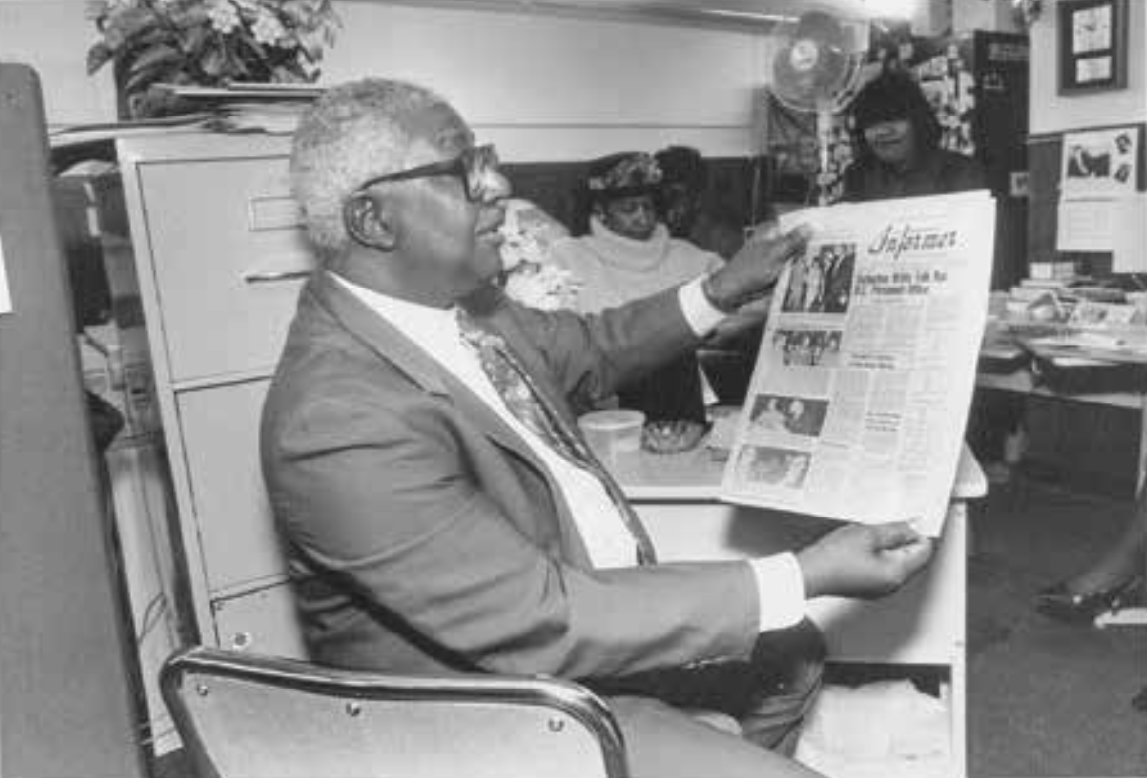
Rhonda Lee Thomas was in her 20s when she was first introduced to The Washington Informer through founding publisher Dr. Calvin Rolark, who established the legacy newspaper on October 16, 1964.
After moving to Southeast, D.C., from a contrastingly white Rapid City, South Dakota in the second grade, Thomas developed a knack for equity and social justice that was fueled during her time at the United Black Fund (UBF), a non-profit organization that supported Black-led charitable organizations to improve the lives of Black and impoverished Washingtonians. The non-profit was founded by Calvin and Wilhelmina Rolark in 1969.
“Calvin has been a champion of Southeast when others have not,” LaVerne Gill, then publisher of Metro Chronicle told The Washington Post in 1988, considering his work with UBF and sponsorship of the National Spelling Bee when other papers would not. “To that extent The Informer is a plus.”
Now, as The Washington Informer prepares to commemorate its 60th anniversary on March 28, its storied commitment to inspire, educate and empower the Black community is celebrated among residents, associates, and longtime supporters who consider the paper pivotal to the preservation of African American culture.
Thomas, 70, applauds the “class paper” for a generational legacy of stewardship, excellence and truth telling that she says has only catapulted with time under the leadership of current publisher and Rolark’s daughter, Denise Rolark Barnes.
“I’m going to go ahead and say The Washington Informer is the backbone of the Black community. [The Informer] has been here for us,” Thomas stated. “I’m just so happy about the fact that as long as I’ve been here in Washington, D.C., as an adult, as a young woman, it has been here for me.”
Celebrating 60 Years as a ‘Lighthouse for the Truth’
One way the award-winning publication has continued its service to Black history is by forging pathways for the next generation of truth-tellers, including offering annual internships and seasonal programs to student and early career journalists.
Fellowships like Chevrolet’s Discover the Unexpected (DTU) have offered aspiring professionals like Juan Benn Jr., an environment to develop the tools and hands-on exposure to propel local storytelling, produce multimedia projects, and understand the realities of the newsroom.
“It’s a very rare experience to get, and I really appreciated [The Informer for] being a part of cultivating young journalists, and giving us a chance to learn and ‘fail’ and try to do things,” said Benn, now an editorial intern at Politico Magazine.
Further, Benn touted the publication’s “particular lens” on Black representation in media, especially in Southeast, the quadrant of the District where The Informer’s office is headquartered on Martin Luther King, Jr. Avenue.
“Stories of Black D.C. aren’t always…highlighted or seen as news, and so for The Washington Informer to step in and do that really important work, it was really inspiring to see that happen in real time,” he told The Informer. “[The Informer] was possibly the smallest news organization I’ve been a part of since I’ve started my journey, but it was probably the most earnest and the most community-based kind of operation.”
Beyond local coverage, The Washington Informer is keen to report national and international news across the African diaspora, and continues to track the storied events that affect Black communities to this day.
Thomas recalls the national news of previous editions, including stories on the rise of Resurrection City and the assassinations of the Rev. Dr. Martin Luther King, Jr., and Malcolm X. She highlighted one of The Informer’s strengths as its ability to inform readers with the principles of journalistic integrity–fairly, accurately, and well.
“The Washington Informer brings all of this to the forefront in a news capacity, without being emotional, without stirring the emotions of the people, and without kissing up,” said Thomas.
This remark comes less than a month after the White House’s historic move to bypass the White House Correspondents’ Association and choose which news outlets are part of the press pool, as well as President Donald Trump restricting the Associated Press access to the White House press room.
Now, more than ever, Thomas said, platforms willing to combat the corruptive ploys to censor the press need to be celebrated.
“The Washington Informer has been a lighthouse for the truth,” she passionately vouched. “We definitely need The Washington Informer, we really need more papers [like it]…that are pro-democracy.”
The Informer Black Culture to Shape Black Legacies
As an alumni of the Cathy Hughes School of Communications at Howard University, Benn says The Informer “beautifully” exemplifies the foundations of the Black Press established 198 years ago on March 16, 1827.
In addition to fostering partnerships like DTU, The Informer propels the next generation of storytellers by epitomizing the core of Black journalists–to be not just of the people, but truly for the communities in which they serve.
“A part of the tradition of the Black press in general [is to treat] Black people with respect in our storytelling, and that’s something that I really saw in action at The Informer,” said Benn, “and it’s something that I want to continue to impart on my own work throughout my entire career.”
For West Virginia native Charlotte Brown, The Washington Informer fulfills a “pivotal” role that all local media should strive towards, especially platforms that represent communities of color.
“With the gentrification and everything that’s been going on in the D.C. metropolitan area, a lot of us…are trying to make sure we can have some understanding of what it means – long-term wise – for our culture,” said Brown. “I think, for me, that’s the way I felt [with The Informer].”
As someone who’s been following The Informer for quite some time, Brown was excited to see the publication’s booth up and running at the 20th Annual MLK Peace Walk & Parade on Jan. 18, another torch passed through generations of the Rolark name.
The celebrated parade – which came into fruition six years before King’s birthday became a federal holiday – is hosted annually by MLK Holiday DC, a committee of individuals and organizations that gather in reverence of King’s life and legacy. Rolark Barnes currently serves as co-chair of the committee, while her father and stepmother, Wilhelmina, were two of the co-founding members.
Thomas commends the generational impact and duty to serve others that remains prominent in Washington at the hands of Informer publishers. She notably touts Rolark’s famed motto, ‘If it is to be, it is up to me,’ as a guided principle that has stuck with her throughout her own journey, both professionally and personally.
“That [saying] has carried me so far in this life, and has helped me to become a person that serves others and wants others to be the best that they can be, and to know that if it’s to be, it’s up to them,” said Thomas, audibly emotional in a phone interview with The Informer.
As Thomas continues to drive change in the community through local activism and partnerships with nonprofits, she maintains her connection with the weekly newspaper by attending events, keeping a box of favorite editions, and uplifting The Informer’s legacy every chance she gets.
“To my knowledge, there is not another paper in the Washington D.C. area, Maryland and Virginia, that’s as comprehensive, as truthful and as unbiased as The Washington Informer,” Thomas said. “Anything Denise does that I know about, I will definitely support in some kind of way.”
To learn more information about The Washington Informer’s 60th Anniversary Legacy Gala – hosted at the Martin Luther King, Jr., Memorial Library on March 28 – visit WIN60Legacy.com, and prepare to bask in the celebration of stories, minds and empowered voices that continue to mold the future of Black history alongside the treasured publication.
“There’s nothing like [the Black press], really there’s nothing like it,” said Benn. “I’m very grateful for Ms. Denise Rolark Barnes and the entire staff at The Informer. I carry the experience that I had…with me everywhere that I go.”